Our project to identify genes for autosomal recessive autism and intellectual disability by studying consanguineous families began in earnest at the beginning of 2006, although we didn’t begin to receive any funding from the Canadian Institutes of Health Research until 2009.
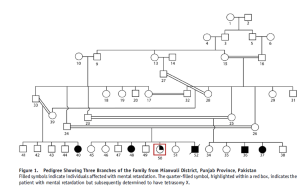
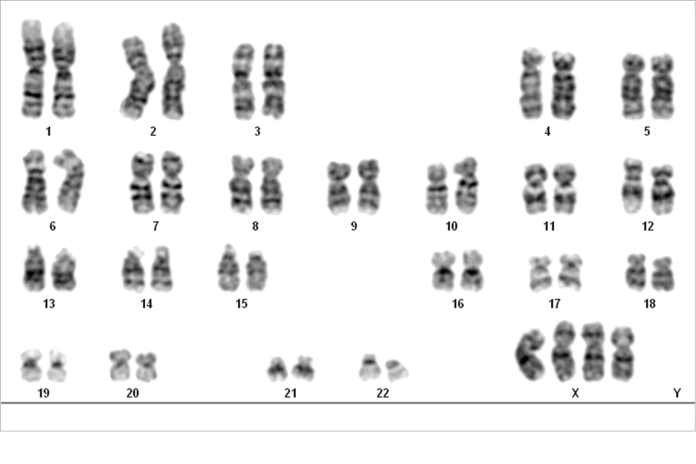
One of the first families we recruited was from a farming community in Mianwali district, Punjab Province, and had three branches with affected individuals, all of which had parents who were first cousins (Fig. 1). The affected members of this family had intellectual disability, and in the oldest affected member there were clear signs of visual impairment.
We also used microsatellite genotyping to confirm the locus, and reported a 2-point lod score of 3.59.
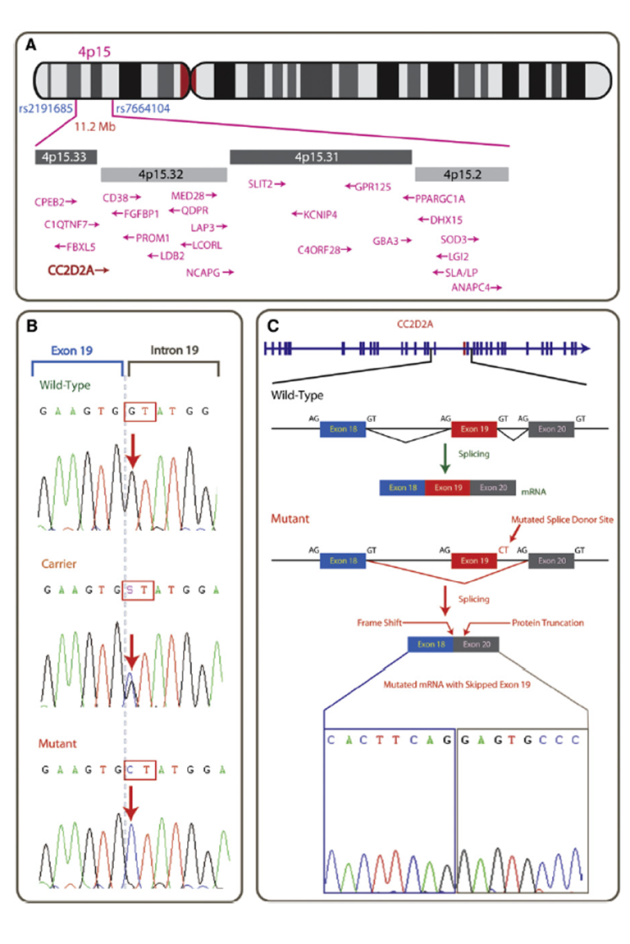
We (or rather Abdul) proceeded with Sanger sequencing all ~30 genes within the homozygous and haploidentical region of 11.2 Mb on chromosome 4p15.33-p15.2 to look for a mutation (Fig. 3).
It was pretty much the last gene, then designated KIAA1345 but now known as coiled-coil and C2 domain containing protein 2A, or CC2D2A, which Abdul found to harbour a homozygous splice-site mutation. We showed, using patient lymphoblast mRNA, that this mutation resulted in the skipping of exon 19, resulting in a frameshift.
The resulting paper was published in the American Journal of Human Genetics in 2008, and is available through the following link: http://www.ncbi.nlm.nih.gov/pmc/articles/PMC2427291/
Several months later in 2008, the group of Dan Doherty at University of Washington, Seattle, reported a mutation in the same gene, CC2D2A, as a cause of Joubert syndrome (Gorden et al, 2009; http://www.ncbi.nlm.nih.gov/pmc/articles/PMC2668034/). CC2D2A is now believed to be one of the genes most frequently mutated in Joubert syndrome, in families from populations where consanguineous marriages are not common as well as in those where it is common. Also, later in 2008, Tallila et al showed mutations in CC2D2A to occur in another ciliopathy, Meckel syndrome.